
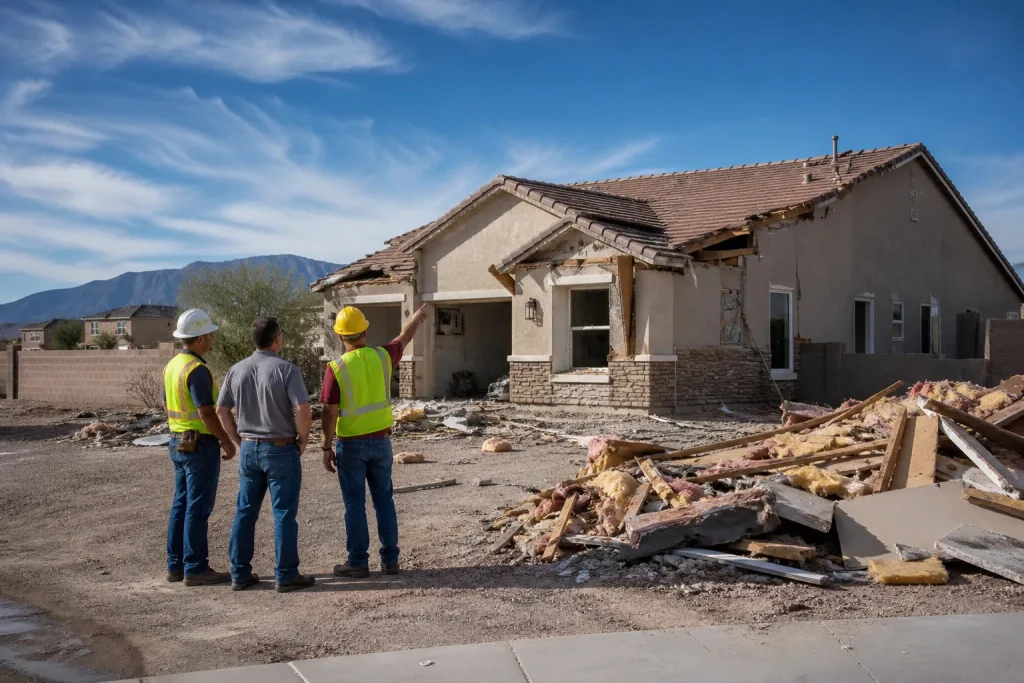
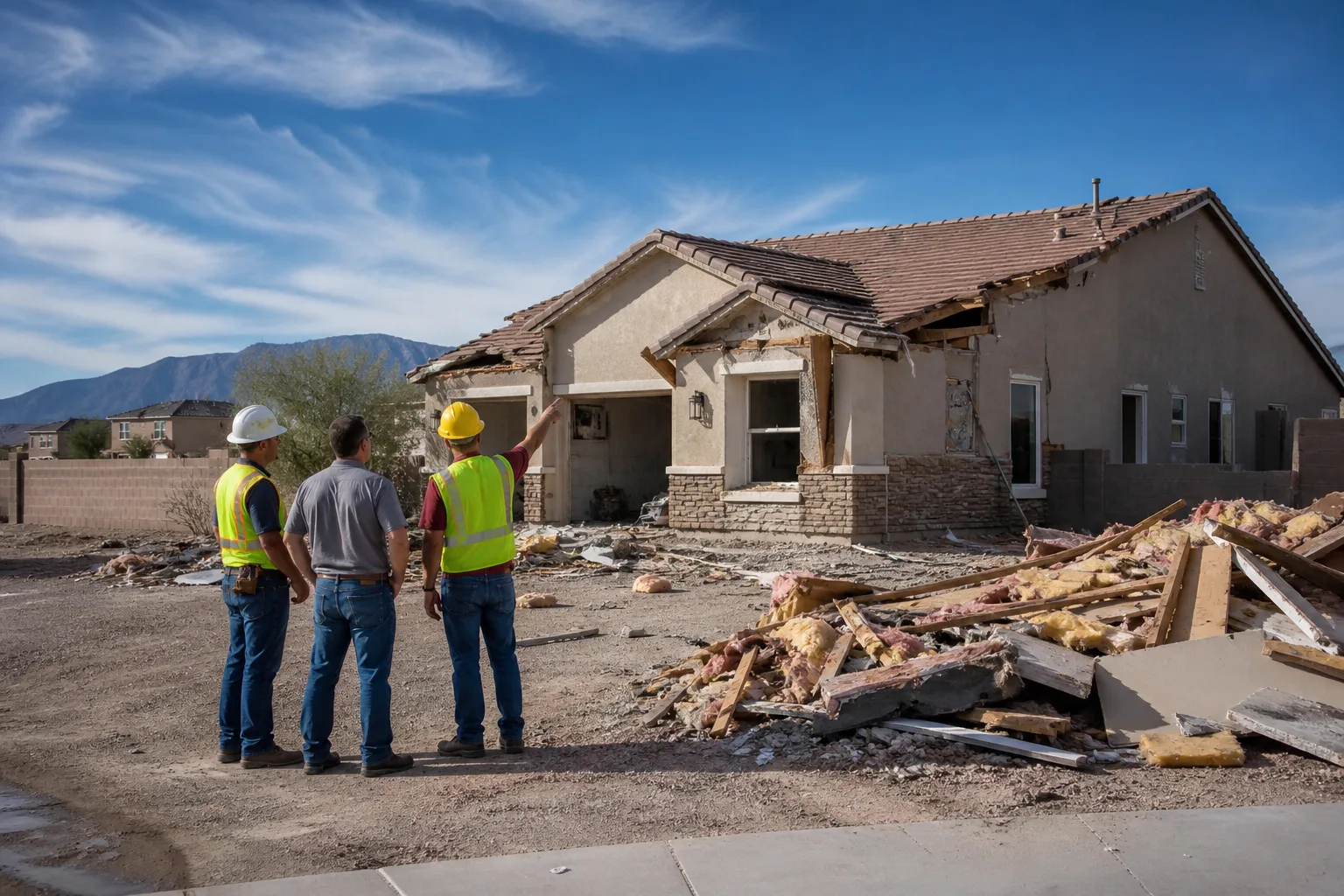
Emergency General Contractor Near Me: What North Las Vegas Homeowners Should Do First
A burst pipe at 11pm feels like a contractor emergency. It’s actually an insurance documentation emergency first. Homeowners who call a contractor before they photograph and mitigate the damage risk a partial claim denial – and in our experience working North Las Vegas claims, that mistake costs more than the repair itself. The first three things you do before you call anyone decide whether your claim holds and whether the water stops spreading. Here’s the sequence that protects both.
If you’d rather hand it to a pro and skip the guesswork, call (844) 834-9656 and we’ll walk you through it.
What should you actually do in the first 30 minutes of a home emergency in North Las Vegas?

Document, mitigate, then call. In that order. It sounds backwards when water is pouring through a ceiling, but the order is what saves your claim.
- Document first (5 minutes). Take photos and video before you touch anything. Wide shots of the room, close shots of the damage, and a shot that shows the source. If water is actively running, a 10-second video with sound is worth more to an adjuster than twenty stills. Note the time.
- Mitigate second (10 to 15 minutes). Shut off the water at the main if a supply line failed. Kill power at the breaker to any wet room before you step in. Move furniture, rugs and electronics out of the path. Put buckets down and towels at doorways. Don’t tear out drywall yet – that’s the adjuster’s call, and ripping before documentation can void the visible-damage portion of your claim.
- Call third. Your insurer’s claims line first, then a licensed contractor for stabilization. Keep every receipt for anything you buy – fans, plastic sheeting, a shop vac rental.
One more thing North Las Vegas homeowners miss: monsoon season here runs roughly June through September, and a single storm can push water through a window seal you didn’t know was failing. That’s why the photo habit matters year-round, not just in a freeze.
What does “emergency contractor” actually mean in Nevada?
It means the person doing emergency stabilization is licensed to do that specific work – and restoration is a separate trade from general contracting. This is the part homeowners get wrong most often.
In Nevada, a licensed general contractor handles structural repair, water damage remediation that involves rebuilding, and the reconstruction that follows a loss. A restoration company handles extraction and drying. Many outfits advertise “emergency contractor” while holding only a restoration or handyman classification. That’s not a scam in every case, but it means they can’t legally pull the permit for the rebuild that comes after.
Before anyone starts, ask three questions:
- “What’s your Nevada license classification, and can I verify it?” The state contractor board lets you look it up by license number in about a minute. Do it.
- “Will you give me a written scope before you start?” Emergency work still gets a written scope. A verbal “we’ll figure it out” is how surprise invoices happen.
- “How do you bill my insurance?” Some contractors want you to pay upfront and chase reimbursement. Others bill the carrier directly. Know which before work begins.
North Las Vegas sits in a climate that swings hard – triple-digit summers, occasional hard freezes in winter – and that swing is exactly what stresses pipes, seals and HVAC systems. A contractor who works here regularly knows the pattern. One who doesn’t will miss it.
What home emergencies hit North Las Vegas by season?
The calendar here drives the damage. Knowing what month you’re in tells you what’s likely to fail.
- Summer (June – September): HVAC failures top the list. A compressor dying at 112 degrees is a genuine health emergency for older residents, and it’s the call we get most in July. Monsoon storms also drive water intrusion through window frames and under patio doors – the flash-flood pattern in the valley sends water where the grading doesn’t drain.
- Winter (December – February): Rare hard freezes stress exposed pipes, especially in garages and on exterior hose bibs. We pulled one out of a garage over in Aliante last winter where a single frozen bib split and ran overnight – the kind of thing that would have been a $40 fix in October.
- Spring and fall: Wind events and sudden temperature swings crack caulk lines and seals, which is when slow leaks start behind walls where you can’t see them.
The pattern matters because it tells you where to look first. In North Las Vegas, check the garage and any exterior plumbing before the first freeze warning, and check window and door seals before monsoon season starts.
When should you stop and call a pro instead of handling it yourself?
Any time water is near an electrical panel, any time a repair involves gas, and any time you’re looking at structural damage. Those are hard stops. Shut off what you can and call.
For smaller stuff – a failed supply line under a sink, a toilet seal, a window that won’t close – a careful homeowner can often mitigate. The line is safety. If the damage touches wiring, a gas line or a load-bearing wall, don’t improvise. That’s the moment to hand it off.
This is where our process differs from a routine remodel. The Sawyer Remodel North Las Vegas home page lays out how we run every job, but in an urgent situation it comes down to three things: a live arrival time so you know when someone is actually coming, photo updates as the work moves, and a written price before any tool gets picked up. That last one matters more in an emergency, not less, because that’s when you’re most likely to say yes to a number you never approved.
Related services in North Las Vegas: if the damage turns into a rebuild, our general contractor in North Las Vegas page covers the structural side, and most water-damaged rooms end up needing either bathroom remodeling in North Las Vegas or kitchen remodeling in North Las Vegas once the drying is done.
How does a photo-update and written-price process work when the situation is urgent?
It works the same as a planned job, just faster. The written price comes before work starts, and the photo updates keep you in the loop even when you can’t be home.
Here’s what that looks like in practice. You call, you describe what’s happening, and we confirm an arrival time you can track. When the tech arrives, you get photos of what they find before they touch anything – which doubles as your insurance documentation if you haven’t taken your own. Then you get a written scope and price. Nothing starts until you approve it. After the stabilization, you get before-and-after photos and a digital invoice you pay from a link.
For the rebuild that follows a major loss, the materials come from named manufacturers – Mr-Glass for the window replacements that often follow storm damage, Therma-Tru and Barrette for doors and fencing, ViewLux for exterior glazing – so you’re not guessing what’s going into your walls. Every project is covered by the 365-Day Done Right Promise, which means if it’s not done right, we make it right, in writing, for a full year after the work closes.
One honest note: we’re a remodeling and general contracting company, not a 24-hour water-extraction outfit. If your basement is filling right now, call a restoration company for the extraction and call us for the rebuild. That’s the honest division of labor, and it’s the one that gets your house back together correctly.
Frequently asked questions
Call your insurance company first, after you’ve documented the damage. Your carrier needs to open the claim and may want to send an adjuster before significant work starts. Then call a licensed contractor for stabilization. Calling a contractor before you’ve photographed anything is the mistake that leads to partial claim denials.
Stabilization usually doesn’t require one, but the reconstruction that follows almost always does. Any structural repair, water heater replacement or electrical work needs a permit pulled by a licensed contractor. Ask before work starts, and don’t let anyone talk you out of it.
It depends on the damage, but you should always get a written scope and price before work begins. Emergency pricing runs higher than planned work because of the timing, and a contractor who won’t put a number in writing before starting is one to walk away from. Call (844) 834-9656 for a free estimate – the price is in writing before anything starts.
Yes. Water damage often reveals older problems – failing subfloor, outdated plumbing, a bathroom that was due anyway. We handle the rebuild from stabilization through finish, and you get the same written price, photo updates and 365-Day Done Right Promise on the whole job. Call (844) 834-9656 to schedule your free estimate.
The Bottom Line
The order is what protects you: document, mitigate, then call. Photograph everything before you touch it, shut off what you can safely shut off, and get a licensed contractor on the phone for the stabilization. Ask for the license classification, the written scope and the insurance billing process before anyone starts. North Las Vegas weather makes certain failures predictable – monsoon water intrusion in late summer, HVAC deaths in July, pipe stress in a hard freeze – so knowing the season tells you where to look first.
If you’re in North Las Vegas and need help, Sawyer Remodel North Las Vegas offers free estimates – call (844) 834-9656. You’ll get a live arrival time, photo updates before and after, and a written price before a single tool gets picked up.
Written by the team at Sawyer Remodel North Las Vegas.
Need Construction Help?
Call Sawyer Remodel North Las Vegas - the local pro we connect you with is licensed and insured, here with fast after-hours help in North Las Vegas.
(844) 834-9656